Monday, August 20, 2012

Qinhuangdao continued

We left Pigeon Nest Park to take a 'cruise' around the bay. The 'cruise' was similar to a ride on the Block Island Ferry--nice but not terribly exciting. The best thing about it was the cool breeze. After the heat and humidity of Beijing, we all relished in the idea of a sea breeze.


While in Quinhuangdao we had a few opportunities to go to the beach. The kids were very excited about the possibility of swimming in the water; me, not so much. The beach was nestled in a little bay called Bohai on the Yellow Sea which the Yellow River flows into.
 
 
Brides everywhere want to have their pictures taken on the beach.
 
We then checked into the Seaside Garden Hotel in a place called Beidaihe. After we had dinner we took a stroll down to the beach and stopped along the way to get some ice cream. Had we known about breakfast, we would have purchased some morning snacks as well. But, alas, that was not to be revealed until the next day.
 
The hotel lobby with Trish and Ada.


Qinhuangdao

This morning we left Beijing and took the two hour train ride to Qinhuangdao. The Beijing train station was quite crowded and so getting onto the train was a trick in itself.
 
 
The train station in Qinhuangdao--a very sane place.


The first view off the train--this is going to be lovely!
 

Pigeon Nest Park


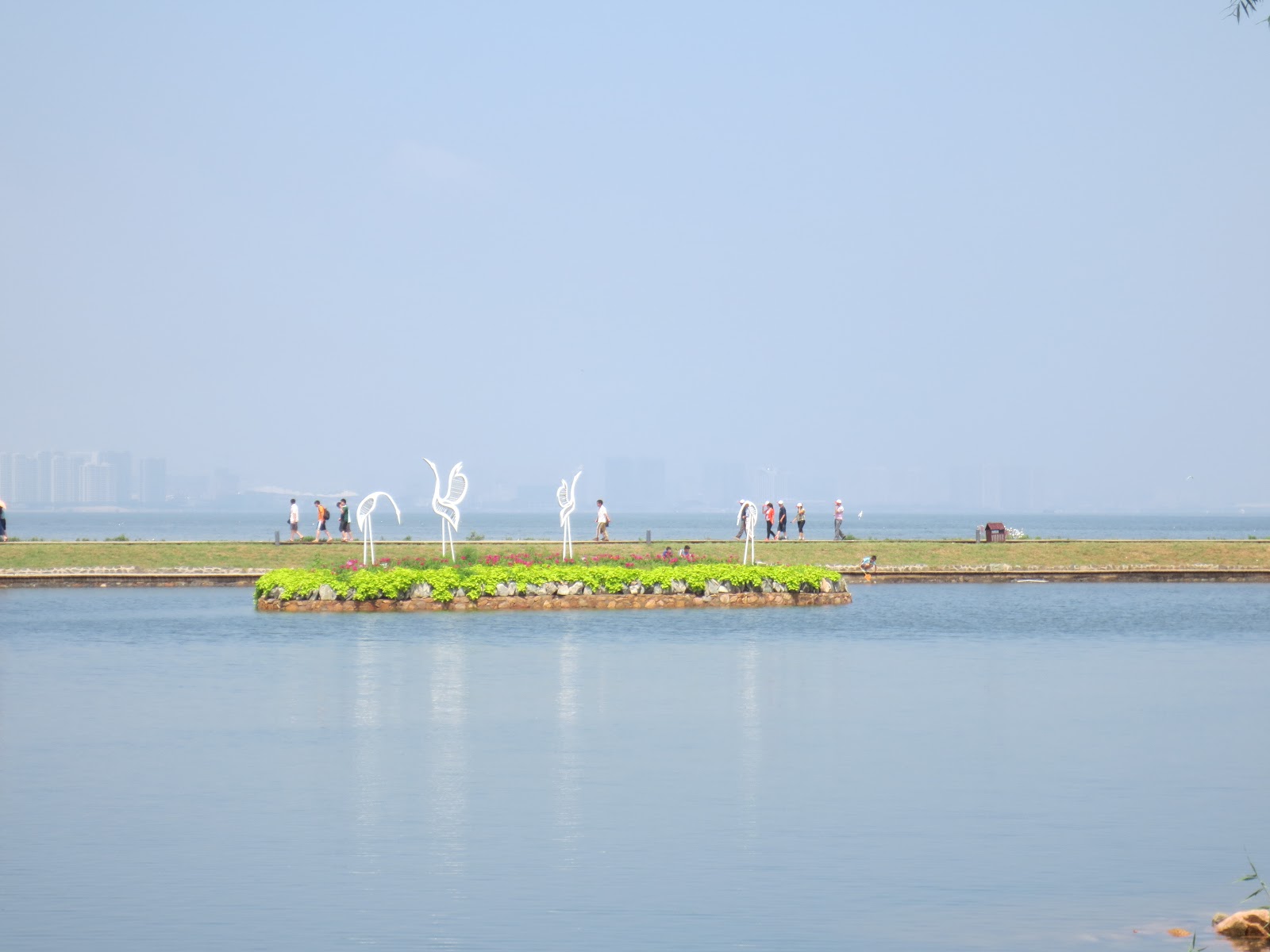
When we arrived in Qinhuangdao Carol, our new tour guide, was at the station to greet us. Since the hotel was not quite ready for us we went to a nearby park called Pigeon Nest Park. This was a lovely site with many beautiful flowers, a view of the China Sea and a nice cool breeze. There was a pavilion and another memorial to Chairman Mao. Qinhuang Dao is the second largest port in China, Shanghai being the largest. The main item passing through this port is coal. In the distance we could see many barges lined up waiting to pass inspection before entering the port.

Changping No. 1 High School


The Open Air Market


This was a pretty low key day. We had a little more opportunity in the morning to relax and take it easy. The only thing on our agenda was a school visit; so Trish and I went around the corner to an open air market. We were intrigued with the sights and smells of the city—some more pleasant than others! Check out these market products.  


Can this guy get one more thing on this bicycle?


For the Chinese students school is everything! It is really their ticket to success. Their school days are very long—an average of 10 hours. Doing well on their exams is the most important thing. It is the entrance into a number 1 high school which is the way into college. In America, all students have the ability to go to some college—there is financial aid, there are alternative colleges, there are choices. If a person does not do well on the entrance exam it limits their choices but they still have choices. If Chinese students do not do well on their exam, a 2 day exam, they will not go to college. All parents want their children to do well and so school is the focus of life for the Chinese young person. Students are very serious about their education. Many have an hour long bicycle ride to school where they will attend classes for 10-12 hours before they get back on their bicycles to ride home.

The STARTALK students and teachers visited a number 1 high school. Our mission was to communicate with the Chinese students in English—give them an opportunity to practice their English before taking their exams. These students have worked very hard to get into this school. Most of them speak English quite well although they all seem shy and afraid to try out their English on us. After introductions we are divided into groups and sent to classrooms to ‘talk’. It was a challenge trying to break the ice but once that happened they all clamored to have their say. They then gave small group tours of their school of which they were very proud. We exchanged e-mails and hopefully will continue the dialogue.


Saturday, August 18, 2012

Summer Palace


It's Tuesday and we are visiting the Summer Palace.
West of Beijing where there are many trees is the summer palace with 5 imperial gardens. The man-made lake covers 75% of the nearly 2 square miles of palace property. The excavated soil, accumulated from the making of the lake, was used to make Longevity Hill upon which stand many of the palace buildings. It served as a summer palace for Empress Dowager Cixi, who used money originally designated for the Chinese Navy to enlarge the palace. The Chinese believe that this diversion of funds weakened the Navy possibly causing them to lose the first Sino-Japanese war, fought in 1894-1895 primarily over control of Korea.


We took a little ride on this cute boat around
Kunming Lake at the Summer Palace.


The bridge to another palace building.


With roommate, Maria.
In a room at the top of this building resides a multi-hand, multi-eyed Buddha.


More stairs---multiple sets of stairs every day! 


We were treated to an acrobatic show in the afternoon. It was an array of typical Chinese acrobatics including many things that seemed very unsafe--multiple motorcycles riding in a spherical cage, chair balancing, bowl balancing. Very scary!


Friday, August 17, 2012

The Great Wall and more


The Great Wall

This morning we visited the Juyongguan portion of the Great Wall.   This section of the wall has been rebuilt. Once it had many guards to defend China’s capital Beijing. You can see from the pictures how beautiful it is and how steep. We climbed over 1,000 steps up in addition to much ramp walking in between. The site is absolutely beautiful and although it was excessively hot, the view and the fact that we were on such an ancient structure, made it well worth the trip.


Cloisonne’

After lunch we visited a workshop where cloisonne’ products are designed. Cloisonne’ is an ancient technique for decorating metalwork objects. The decoration is formed by first adding compartments to the metal object by soldering or adhering silver or gold wires or thin strips placed on their edges. An enamel powder made into a paste is then put into the compartments. Several kiln firings are required between the layering of the paste. Jewelry, vases and decorative items were all available at this workshop and store.


Olympic Park in Beijing


In 2008 when the summer Olympics were in China, the events took place in six different cities including Hong Kong and Shanghai as well as Beijing. We saw the Water Cube, site of the swimming events, and the Bird’s Nest which is the National Stadium. According to ancient Chinese lore, round (the shape of the Bird’s Nest) represented the sky and square (the shape of the Water Cube) represented the earth. The water has been removed from one of the pools which is currently being used as a location for musical performances. One of the other pools has been converted into a water park. When we visited the stadium, it was offering opportunities for tourists to ride segways around the track.

Advertisement for the 2012 London Olympics

The water park in the cube

The torch originally had been atop the Bird's Nest but is now at ground level.

Beijing


Beijing

Much of the travel that we will do in the city will be by bus. It’s been a while since I have been on a bus so I don’t remember if all buses have horrific fumes or if it is the gas that is used here that makes this bus so smelly but I try to keep my mouth closed while traveling—yuck!
 Today is a full day.
 In 2008 when Beijing hosted the summer Olympics the physical size of the city was increased. Many of the neighboring areas that housed privately owned homes called quadrangles were torn down to make way for the new Beijing. The infra-structure was much improved and highways were built circling the city.


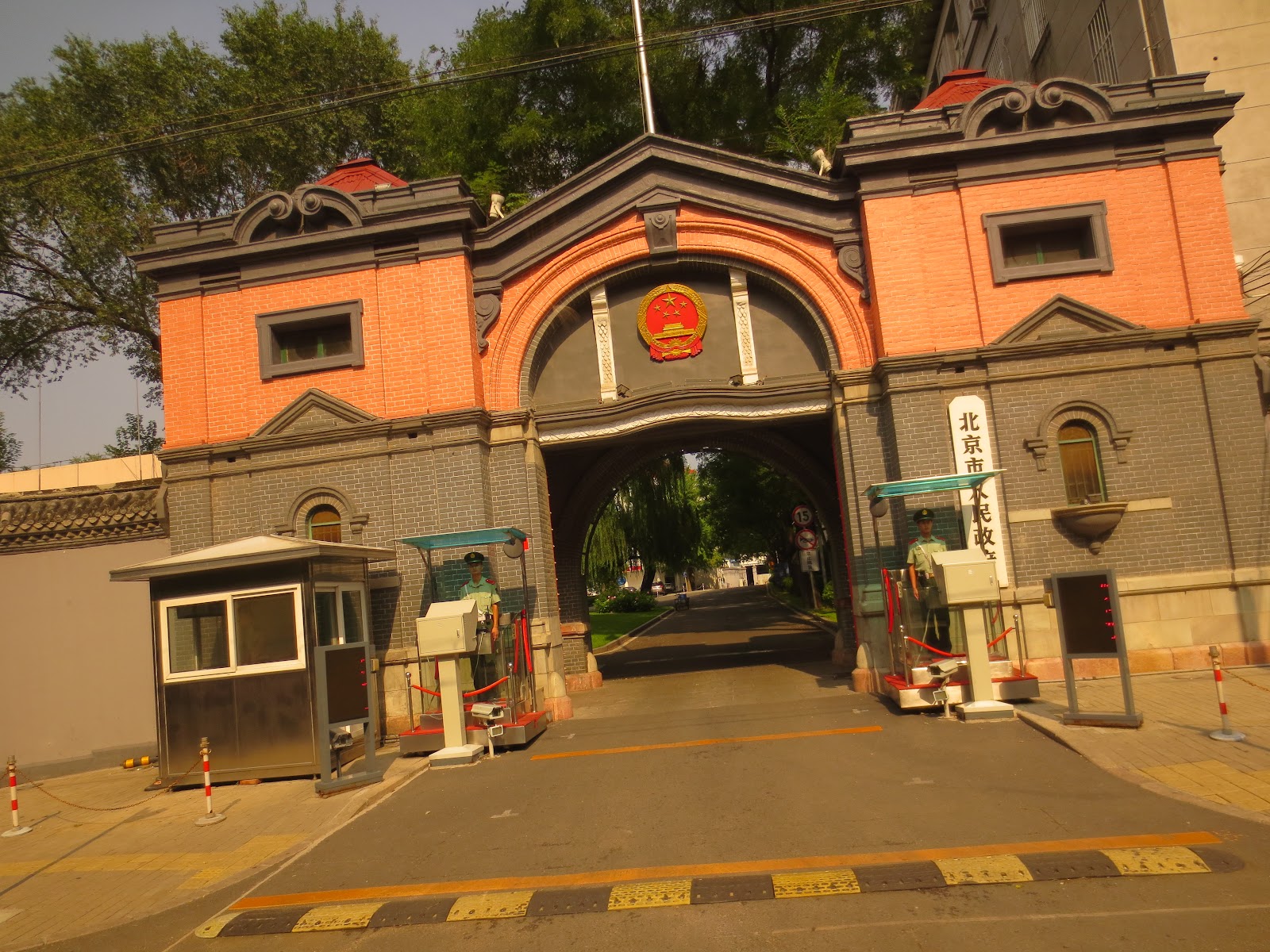
This is one of the remaining gates, complete with guard, 
from the wall that once surrounded the city.

There are two portions of the wall remaining;
this is one of them.


Tiananmen Square


Our first stop was Tiananmen Square. The Tiananmen Gate to the Forbidden City was built in 1415 during the Ming Dynasty; the Square was not built until 1651 and over the course of time has quadrupled in size. This site is a common meeting place as well as a ceremonial site; it has been the site of political events as well as student protests. It is the location for Chairman Mao’s announcement of the creation of a new China on October1, 1949.The Chinese people have a great respect and love for Mao, something that is very hard for Americans to understand. They say that Americans have no idea of what China was like prior to Mao’s arrival on the scene. It is also the site of the 1976 and 1989 protests which resulted in suppression and the deaths of many protestors. The Communist Party forbids discussion of the Tiananmen Square protests.


The opening above Mao's picture is the spot where he declared the
 formation of the People's Republic of China in 1949.
Here's a close-up of the speech location.


Monument to the people


The Forbidden City

Entrance to the Forbidden City

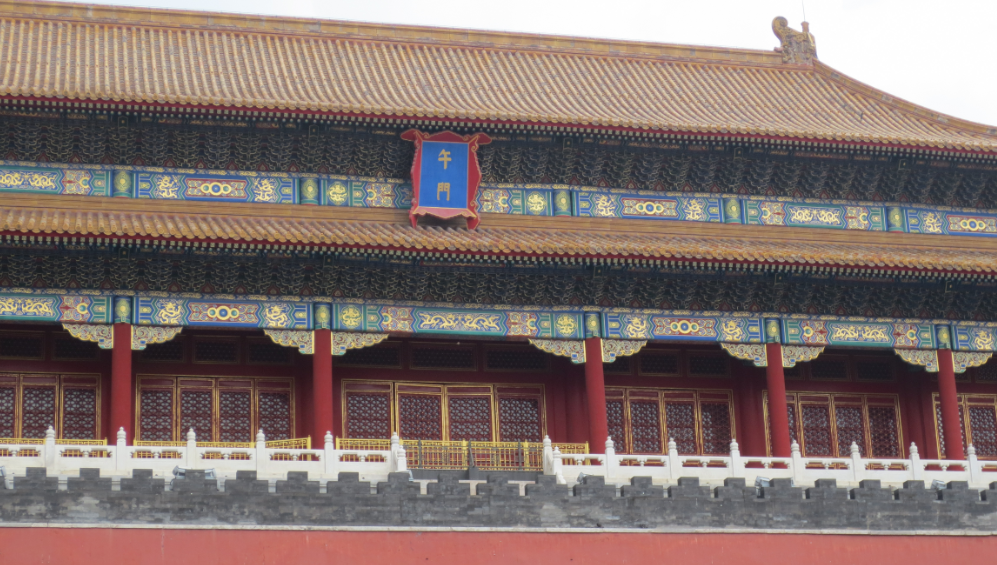
Next we visited The Forbidden City. This is where the emperor and his households lived and it is the heart of the city. It was also the ceremonial and political center of Chinese government. It was the Chinese imperial palace from the Ming Dynasty (1368-1644) to the end of the Qing Dynasty (1644-1912). Construction on The Imperial Palace began in 1406 and was completed in 1420. More than one milion workers were needed to complete the work. The complex consists of 980 buildings.  It is exquisite and is an example of the ancient Chinese architectural style that is seen throughout Old Beijing. In 1925 it was established as the Palace Museum.

This was the 'home-school' for the young emperor.

These cauldrons were placed in the city to collect water; they were originally gold plated. During the second opium war in 1860 the Anglo-French invaders scraped the gold off and harvested it.
Details of a roof in the Forbidden City.
The throne in the palace.


Beijing Urban Planning Exhibition 

Our final stop before dinner was the Beijing Urban Planning Exhibition. When I saw this on the itinerary I couldn’t imagine what it was or why it would be of interest to a tourist. I was quite astonished when we actually entered the building and saw the various stages of the city’s development. There were models, a huge floor layout of the city with an accompanying laser show that lit up the portions of the model that were being discussed on the screen. Very cool.

 
The model of the city that accompanied the laser show.
The lit blue square is the Forbidden City, the seat of the Ming Dynasty from 1420-1644.Today the Chinese refer to it as the "Former Palace". It had been the home of 24 emperors--14 Ming and 10 Qing.


A different model of the city.


Who are all of these famous people on the city streets?


A typical dinner setting

I'm on the throne at last!
This elaborate throne was in the restaurant.